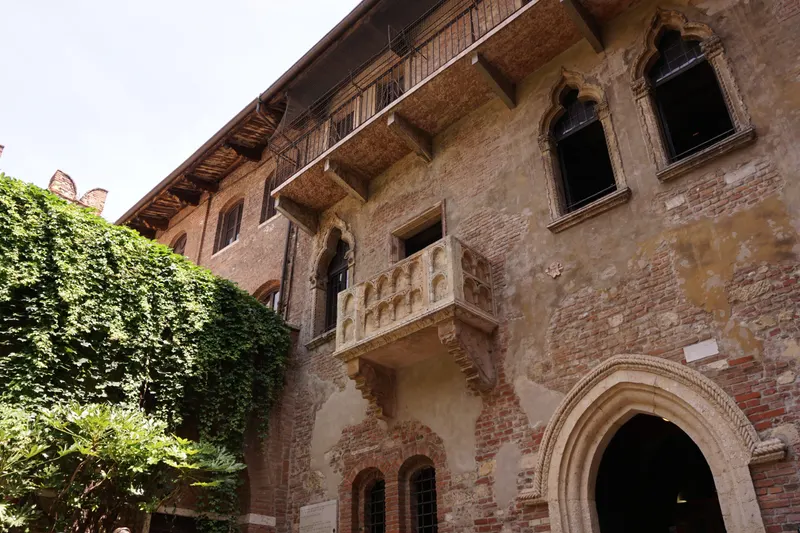
Casa di Giulietta — the medieval brick house in Verona's Via Cappello, with the balcony made famous by Romeo and Juliet

Stand under Juliet's balcony, in Verona

Casa di Giulietta — the 14th-century house with the balcony added in 1939. Entry from Teatro Nuovo, Piazzetta Navona. Skip-the-line interior visit, your slot reserved.

See ticket options
  • 14th C. Medieval brick tower house
  • UNESCO 2000 Verona inscribed as World Heritage
  • 1939 Balcony added by Antonio Avena
  • 1973 Bronze Juliet by Nereo Costantini

Choose your ticket

Theatre + Courtyard only

All ages 6+

€18

  • Teatro Nuovo (monumental hall + foyer) on entry
  • Juliet's Courtyard with the bronze statue + balcony
  • Photo of the balcony from the courtyard
  • Does NOT include the Casa di Giulietta house interior
  • 5-minute audio history sent before your visit
Reserve my ticket
4.8 from 96 verified travellers
Charlotte F.
Manchester, England
“We arrived at our 11:00 slot, walked past the courtyard queue, and were on the balcony in under five minutes. The audio guide before the trip was the best part — turns the whole literary fiction into a much more interesting story.”
March 2026
Lukas H.
Vienna, Austria
“Booked from our hotel the night before. Got a 14:00 slot the next afternoon. Whole thing took 45 minutes — perfect coffee-break museum on a Verona walking day.”
February 2026
Miguel R.
Mexico City, Mexico
“Smaller museum than I expected but the costumes from the Zeffirelli film and the balcony were lovely. The concierge replied to a date-change in two hours.”
February 2026
  • Refund if we can't deliver Full money back if your slot can't be secured
  • Real humans, not bots English-speaking concierge, not AI
  • Pay in your local currency Same price at checkout · no FX surprise
  • No hidden fees Total shown upfront · what you see is what you pay

About Casa di Giulietta

Casa di Giulietta — Juliet's House — is the 14th-century brick tower house in Verona's historic centre that the world has chosen to associate with Shakespeare's tragedy. The connection is a layered literary fiction stacked on a real medieval building: the original house belonged to the Capello family, whose hat-shaped heraldic emblem (capello means 'hat' in old Italian) was reinterpreted in the 18th and 19th centuries as a link to Shakespeare's Capulet family. The municipality of Verona has owned the building since 1905; in 1939 the architect Antonio Avena added the famous balcony — fashioned from a medieval marble sarcophagus and existing civic stone — to give the courtyard the photographic centerpiece visitors come for.

The interior is preserved as a small museum operated by Musei Civici di Verona. Visitors walk through frescoed medieval rooms, reproductions of Renaissance furniture, costumes from Franco Zeffirelli's 1968 film of Romeo and Juliet, and historical material on the Capello family. A short stair leads onto the balcony itself — the centerpiece of every Verona honeymoon photograph since the 1940s.

From 1 April 2026 the entry procedure changed: the historic Via Cappello door is closed and all visitors enter through Teatro Nuovo in Piazzetta Navona, a few steps from the original courtyard. Both the courtyard with the bronze Juliet statue and the museum interior now require a ticket — there is no free walk-in to the courtyard. Verona itself was inscribed by UNESCO as World Heritage in 2000, recognising the city's exceptional concentration of Roman, medieval, and Renaissance architecture.

Practical information

Opening hours
Tuesday–Sunday 09:00–19:00 (last entry to the Casa 18:30; last entry to the courtyard 18:40); Monday 14:00–19:00. Closed 25 December and 1 January. Hours subject to seasonal adjustment by Musei Civici di Verona — confirm on the day if travelling around Christmas, New Year, or Easter.
Entrance
From 1 April 2026, all entry to Juliet's Courtyard and Juliet's House is via Teatro Nuovo, Piazzetta Navona — not the historic Via Cappello door, which is no longer in use.
Address
Teatro Nuovo, Piazzetta Navona, 37121 Verona, Italy. The historic Casa di Giulietta address (Via Cappello 23) is now closed to public entry — the actual house is reached through Teatro Nuovo.
Getting there
From Verona Porta Nuova rail station: 20-minute walk through the historic centre to Piazzetta Navona, or bus 11/12/13 to Piazza delle Erbe (3-minute walk from there to Piazzetta Navona). The whole quarter is pedestrian-only — no driving access. Look for the Teatro Nuovo signage; the door to Juliet's House is now inside.
Accessibility
Teatro Nuovo (the entry building) has lifts and step-free access to the courtyard. The medieval Casa di Giulietta upper floors and the balcony itself are reached by stairs and are not wheelchair-accessible. The courtyard with the bronze statue is accessible. Contact Musei Civici di Verona in advance for specific accessibility support.
Bag policy
Small bags allowed inside. Large backpacks must be checked at the Teatro Nuovo entrance.
Photography
Personal photography permitted throughout. Tripods and commercial photography setups restricted. The bronze Juliet statue and the balcony are on every visitor's photo list.

About our service

Casa di Giulietta Tickets is an independent booking service operated for international visitors. We facilitate timed-entry tickets sourced from Musei Civici di Verona, the official Comune di Verona operator. From 1 April 2026, entry to both Juliet's Courtyard and Juliet's House requires a ticket, with a single entrance through Teatro Nuovo in Piazzetta Navona. Our concierge service fee is included in the displayed price.

Frequently asked

Is Casa di Giulietta really Juliet's house?

It's a layered literary fiction. The original 14th-century house belonged to the Capello family — their heraldic hat-shaped emblem ('capello' = old Italian for 'hat') was reinterpreted in the 18th and 19th centuries as a link to Shakespeare's Capulet family. The famous balcony was added in 1939 by architect Antonio Avena to give the courtyard a photographic centerpiece. Shakespeare himself almost certainly never visited Verona.

Do I need a ticket to see the balcony?

Yes — the rules changed on 1 April 2026. Entry to Juliet's Courtyard (where you stand below the balcony) and Juliet's House (where you step onto it) is now ticketed for everyone, with a single entrance through Teatro Nuovo in Piazzetta Navona. The historic Via Cappello door is closed. Two ticket levels exist: Theatre + Courtyard only (you photograph the balcony from below) or the full Theatre + Courtyard + Casa di Giulietta (you step onto the balcony itself).

Where do I actually enter? Via Cappello or Teatro Nuovo?

Teatro Nuovo, on Piazzetta Navona — a 30-second walk from the historic Via Cappello address. As of 1 April 2026, the Via Cappello door is permanently closed to public entry. Look for the Teatro Nuovo signage; the courtyard and the house museum are reached through the new entrance hall and foyer.

What's included in each ticket?

Both tickets include the Teatro Nuovo monumental hall and foyer (the new entry experience) plus Juliet's Courtyard with the bronze statue. The €28 House + Theatre + Courtyard ticket adds the medieval museum interior — frescoed rooms, period furniture, Zeffirelli's 1968 Romeo and Juliet film costumes, historical exhibits, and stair access to the famous balcony itself. The €18 Theatre + Courtyard ticket gives you the courtyard photo without the museum interior.

Are children, disabled visitors, or Verona Card holders charged?

No. Children under 5, disabled visitors with a Disability Card and one companion, and Verona Card holders enter free of charge — they do not need to buy a concierge ticket from us. Tour guides accompanying a group also enter free. If anyone in your party falls into one of these categories, just buy concierge tickets for the rest; the operator will admit the free-entry visitors at the door on production of the relevant ID or pass.

When should I arrive?

10–15 minutes before your booked slot at the Teatro Nuovo entrance in Piazzetta Navona. Arriving earlier is fine but you won't be admitted before your time. Piazzetta Navona itself is a small public square outside the new entrance — find a coffee on a nearby Via Cappello terrace while you wait, then walk in when your slot opens.

How long does a visit take?

30–60 minutes for the interior. Add 15–30 minutes for courtyard photos and the bronze Juliet statue (where the rub-her-right-breast-for-luck tradition has worn the bronze visibly thin).

Is the museum open year-round?

Yes — Tuesday to Sunday 09:00 to 19:00 (last entry to the Casa 18:30; last entry to the courtyard 18:40), and Monday 14:00 to 19:00 — the late Monday opening is unusual and a useful planning fact. Closed on 25 December and 1 January. Hours can adjust for other public holidays — confirm on the day if travelling on Easter Sunday, Ferragosto, or Republic Day.

Can I change my date or time?

Once booked, slots are non-transferable and non-refundable. If you need to change, contact us at bookings@julietshouseverona.com — we'll help where we can but cannot guarantee a new slot in peak season.

Is it suitable for children?

Yes. The museum is small and the visit is short enough for younger visitors. The courtyard has the bronze Juliet statue, the wall of letters, and the balcony — all photographable. Strollers fit through the museum but the upper-floor stairs are unavoidable.

Is the museum wheelchair-accessible?

Partially. Teatro Nuovo (the new entry building) has lifts and step-free access to the courtyard, so the courtyard with the bronze statue is reachable for wheelchair users. The medieval house upper floors and the balcony itself are stair-only and have no lift. Contact Musei Civici di Verona in advance for specific accessibility advice.

What's your refund policy?

Tickets are issued for a specific date and are non-transferable once issued. If your plans change, reply to your confirmation email at least 48 hours before your date and we'll do our best to move you to a new available slot.