 Skip-the-line available
 The Best Time to Visit Casa di Giulietta
A month-by-month guide to crowds, weather, light, and the Valentine's and Ferragosto peaks that shape every visit to Juliet's House in Verona.
Casa di Giulietta is a small museum inside a 14th-century brick tower house, fed by a courtyard that has been a fixed stop on the Verona walking circuit since the 19th century. Because the interior is genuinely small — typically 30 to 60 minutes for a complete visit — small differences in queue length and crowd density have an outsized effect on how the day feels. From 1 April 2026 entry is via Teatro Nuovo in Piazzetta Navona, with a per-slot capacity of around 50 visitors every 15 minutes, which makes timing more important than it was under the old free-courtyard regime. This guide breaks down the year month by month, covers the two pressure peaks (Valentine's Day in February and Ferragosto in August), and identifies the quiet windows where the courtyard is calm enough for a long look at the balcony.
How the Verona Calendar Shapes Casa di Giulietta
Verona's tourism calendar has two distinct rhythms — a steady international flow driven by Shakespeare's Romeo and Juliet, and a sharper Italian-domestic rhythm tied to the Verona Arena opera season, the Vinitaly wine fair, and the school-holiday pattern of Northern Italy. Casa di Giulietta sits at the intersection of both. International visitors arrive year-round and lean toward the morning hours; Italian day-trippers concentrate on weekends and on the four anchor events (Valentine's Day, Easter, the late-June opera-season opening, and Ferragosto on 15 August). The combined effect is that an apparently quiet Tuesday in October can be much busier than the same Tuesday in late January, because the Verona Arena opera matinees are still in residual scheduling and the regional autumn-break weeks add domestic traffic.
Visitor flow inside the courtyard is shaped by the new Teatro Nuovo entry procedure introduced on 1 April 2026. Both the courtyard with the bronze Juliet statue and the house museum require a ticket, and the operator releases 15-minute timed slots with a per-slot cap. This means crowd pressure no longer concentrates at the courtyard gate the way it did under the historic Via Cappello regime — it now distributes across the day in 15-minute pulses. The practical effect is that mid-morning and mid-afternoon slots fill earliest, and the very first slot (09:00 Tuesday to Sunday, 14:00 Monday) is consistently the quietest interior visit.
Month-by-Month: What to Expect Across the Year
January is the single quietest month at Casa di Giulietta. The courtyard is sometimes nearly empty on mid-week mornings, the museum interior takes 30 minutes without queues, and timed slots can be secured on the day. February is also quiet — until the build to Valentine's Day. The city runs Verona in Love programming around 14 February, and the courtyard becomes a focal point for engagements, photo sessions, and Italian regional couples making a day trip. Numbers spike sharply for roughly four days each side of 14 February, then settle back to normal February quiet. March marks the transition: longer days, milder air, and the first wave of international shoulder-season visitors begin to arrive, with weekend numbers climbing from mid-month.
April through June is widely considered the strongest window. Temperatures are mild to warm, the courtyard light is good for photography, and crowds — while present — remain manageable on weekday mornings. The Verona Arena opera season opens in mid-June, which adds an evening tourism layer to the city but does not directly compete for Casa di Giulietta slots. July is busy. August is the peak month, and Italian Ferragosto week (around 15 August) is the single densest stretch of the year — northern Italians take their main holiday, international visitors continue to arrive, and the courtyard runs at full slot capacity from late morning to early evening. September eases gradually, October offers a strong shoulder-season balance, November returns to genuine quiet (with the bonus of crisp light), and December brings the Verona Christmas markets in Piazza Bra and Piazza delle Erbe — which lift the city's mood without significantly raising Casa di Giulietta numbers.
The Valentine's Day Peak and How to Plan Around It
Valentine's Day at Casa di Giulietta is a marketing high point rather than a meaningful change in what the site offers. The museum and courtyard run on normal opening hours, and the operator does not release special tickets or programming inside the house itself. What changes is the city around it: Verona's Verona in Love festival fills Piazza dei Signori with stalls and red-lit installations, the courtyard becomes a busy backdrop for proposals and photo shoots, and slot availability tightens noticeably for the week of 11 to 18 February. If you specifically want the Valentine's-Day atmosphere — the courtyard buzzing, the wall of letters at peak density, the city decorated — book three to four weeks ahead and target an early slot to clear the museum before the afternoon pressure builds.
If you want to avoid the peak, the second half of February is excellent. Numbers drop sharply from 16 February onward and the rest of the month is calm. Travellers who happen to be in Verona during the festival but do not want the crowd can take the 09:00 Tuesday-to-Sunday opening slot or the late 17:00 to 18:30 window — the courtyard genuinely thins after 17:30 even on 14 February. The Monday 14:00 opening is also useful as a counter-rhythm: if Valentine's Day falls on a Monday, the late opening compresses the day's pressure into fewer hours and the first 14:00 slot can be remarkably quiet.
Weekly Rhythm: Quietest and Busiest Days
Casa di Giulietta's weekly pattern is shaped by Verona's role as a day-trip destination from Milan, Venice, and the surrounding lakes. Saturday is consistently the busiest day, followed by Sunday and then Friday. Tuesday is mid-week busiest because it picks up cruise-passenger excursions arriving via Venice and a higher share of organised group itineraries. Wednesday and Thursday are the calmest weekdays. Monday is a useful anomaly: because the site opens at 14:00 rather than 09:00, the morning hours are simply unavailable, and the afternoon slots compress what would otherwise be a full-day flow into five hours. The first Monday slot at 14:00 is genuinely calmer than a typical Saturday morning.
If your schedule is flexible, a Wednesday or Thursday outside Italian school holidays gives the calmest possible experience. If only weekend slots work, take Sunday morning over Saturday — Sunday brunch in Italy keeps domestic visitors in their kitchens longer, and the 09:00 to 10:30 window is the day's clearest. Verona's school calendar adds pressure during the Easter break, the long summer from mid-June to early September, and the Christmas-New-Year period. Sant'Anastasia, Castelvecchio, and the Roman Theatre absorb school-trip groups in parallel, so Casa di Giulietta is not exceptionally hit by classroom visits — but the city itself is busier on those weeks.
Light, Photography, and the Balcony Photo
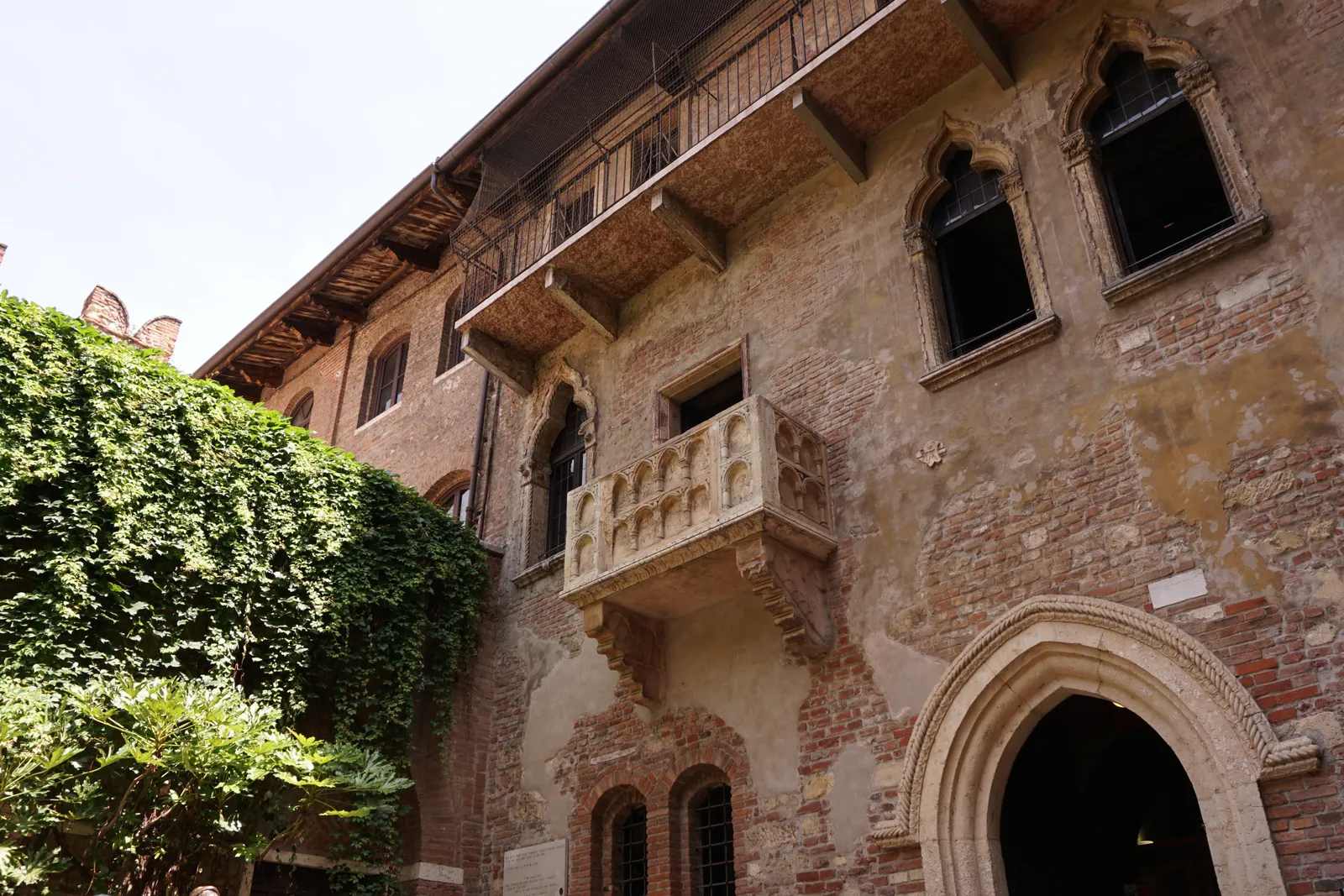
The Casa di Giulietta courtyard is small and walled, which controls how light enters across the day. The balcony itself faces roughly south-southeast, so it catches direct morning sun from about 09:30 in summer and through the late morning in winter. By mid-afternoon the wall is in shadow, which gives a more even, diffuse light — many photographers prefer this for portraits because it removes the harsh contrast on the medieval brick. The bronze Juliet statue on the courtyard floor catches direct sunlight from about 11:00 to 14:00 in summer; in winter the sun rarely reaches the statue directly. The best window for the classic wave-from-below photo is the first hour after opening on a clear morning, when the light is on the balcony and the courtyard is still thinly populated.
Cloudy and lightly misty mornings can be unexpectedly good. The medieval brick reads warmer in flat light, the balcony's deliberate Gothic styling photographs more sharply against a grey sky than against blue, and the courtyard's small crowd does not produce the colour-noise of a sunny midday. Verona's autumn and winter weather often delivers exactly this kind of light. Tripods are restricted inside the courtyard and museum, so handheld with a steady lens is the practical approach. The wall of letters — the marked surface near the balcony — is best photographed in afternoon shadow when the texture of the paper and tape is most visible.
Frequently asked
What is the absolute quietest time to visit Casa di Giulietta?
A Wednesday or Thursday in mid-January, at the 09:00 opening slot. The courtyard is sometimes nearly empty, the museum takes 30 minutes without queues, and same-day slots are usually available.
Is Valentine's Day worth visiting Casa di Giulietta?
Yes if you want the atmosphere — the courtyard at peak energy, the Verona in Love festival in the surrounding squares, the wall of letters at maximum density. No if you want a quiet museum visit; the week of 11 to 18 February is the densest of the calendar.
When does Ferragosto affect Casa di Giulietta?
The week around 15 August is the single busiest stretch of the year. Italian domestic tourism peaks, international visitors continue to arrive, and the courtyard runs at full slot capacity from late morning to early evening. Book early-morning or late-afternoon slots, and book at least one week ahead.
Is Monday a bad day to visit because of the late 14:00 opening?
No — Monday is often calmer than a typical Tuesday because the morning hours are simply unavailable, so the day compresses into the 14:00 to 19:00 window. The first 14:00 slot is genuinely quiet, and the late opening sidesteps Tuesday's cruise-passenger excursions from Venice.
What's the best month for photography in the courtyard?
April, May, October, and November combine good light with manageable crowds. November in particular delivers warm low-angle light on the medieval brick and the lightest weekday traffic of any of those months.
How does Verona Arena opera season affect Casa di Giulietta?
The Arena opera season runs from mid-June to early September and adds an evening tourism layer to the city, but it does not directly compete for Casa di Giulietta slots — opera-goers concentrate at the Arena in late afternoon and evening, while the museum closes by 19:00.
Is Christmas a good time to visit?
Yes. December is generally calm at the museum itself, the Christmas markets in Piazza Bra and Piazza delle Erbe lift the city's atmosphere, and timed slots are easy to secure. The site is closed on 25 December and 1 January, but the days around are normal.
How early should I book in peak season?
For Saturdays in July and August, Ferragosto week, and Valentine's Day, book at least one week ahead. Other peak-season weekdays usually need 3 to 5 days. Shoulder months and winter weekdays can typically be secured 1 to 2 days out.
Does the museum get less busy late in the day?
Yes. The 17:00 to 18:30 slots are noticeably calmer than mid-afternoon slots in any season. The last entry to the Casa is 18:30 and to the courtyard 18:40, so late slots also benefit from the natural end-of-day thinning.
Is the courtyard accessible after the museum closes?
No. Since 1 April 2026 the courtyard requires a ticket and is accessible only through the Teatro Nuovo entrance during operating hours. After 19:00 the gates close and no public access remains until the next morning.