 Skip-the-line available
 The Cappello Family and the Real History of Juliet's House
Before the balcony, before the bronze, there was a medieval tower house, an inn called Il Cappello, and a family whose name sounded almost — almost — like Capulet.
Juliet Capulet never lived at Via Cappello 23, because Juliet Capulet never lived anywhere. What stood at that address, first documented in 1351, was a medieval tower house that spent centuries as an inn called Il Cappello — the Hat — owned by the heirs of a Veronese family whose name adorns the street to this day. The distance between that documented, workaday history and the balcony-crowned shrine visitors book timed slots for is the most interesting thing about Casa di Giulietta, and this guide walks it honestly: the real Cappello family, the real medieval building, the 18th-century moment the legend attached itself to the address, the city's shrewd 1905 purchase, and the 20th-century curator who gave the story the architecture it needed. Knowing all of it does not diminish the visit. It turns a photo stop into one of Europe's great case studies in how places and stories choose each other.
Before Shakespeare: Cappelletti, Montecchi and Dante's Verona
The names came before the play — by almost three centuries. Dante, who spent part of his exile in Verona in the early 1300s, name-checks the Cappelletti and the Montecchi in the Purgatorio, invoking them as examples of the faction-torn nobility of the Italian cities. Whether the historical Cappelletti were even Veronese is debated by historians, and Dante says nothing about star-crossed lovers; the two names simply entered literature as a matched pair of feuding houses. That pairing was the seed. When later storytellers needed two families divided by an old grudge in a northern Italian city, the Cappelletti and Montecchi were already on the shelf, pre-loaded with Dantean gravitas.
The love story itself was built in the 16th century by Italian novella writers. Luigi da Porto — a Vicentine soldier and author whose name now marks the street beside Juliet's Tomb — set a tragic romance between Romeo and Giulietta in Verona, attaching it to the feuding families; Matteo Bandello and others retold and embellished it, and translations carried it north to England, where Shakespeare found it. By the time Romeo and Juliet reached the London stage in the 1590s, the tale had been polished by half a dozen hands, and Verona was fixed as its setting. Shakespeare, as far as anyone can establish, never saw the city he made immortal.
None of this involved a specific house. The novellas and the play name no address; medieval and Renaissance Verona had no plaque marking the Capulet residence, because nobody thought of the story as attached to real property. That step — the conversion of a literary setting into visitable real estate — belongs to the modern tourist age, and it required a candidate building with the right name in the right city. Via Cappello had one waiting.
The House on Via Cappello: An Inn Called Il Cappello
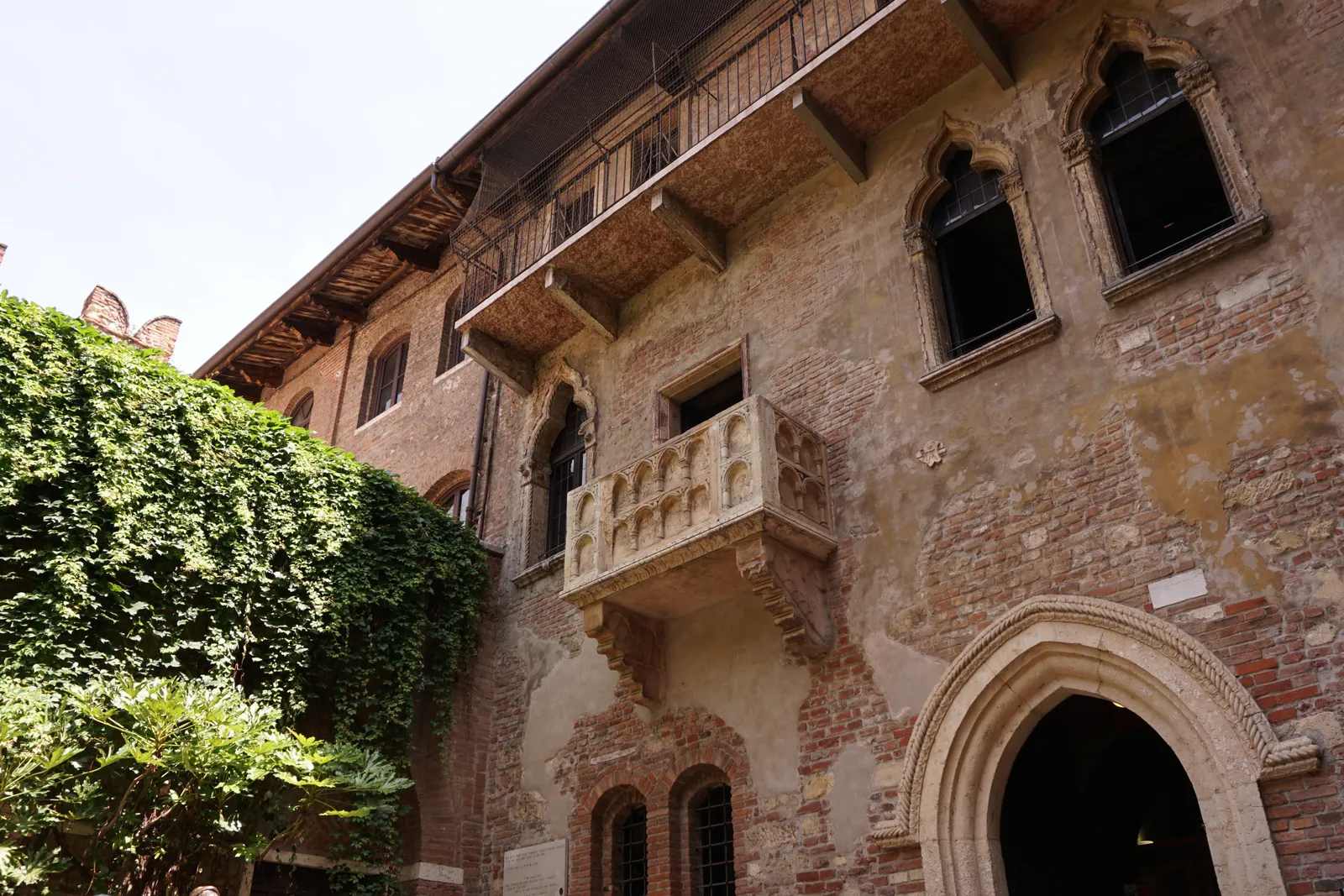
Strip away the legend and the building at Via Cappello 23 is a genuinely fine piece of medieval Verona: a brick tower house whose presence is first attested in documents dated 1351, rising over a small internal courtyard in the dense mercantile quarter between Piazza delle Erbe and the river. For much of its later history it was not a noble residence at all but a working inn with artisan workshops attached — the locanda del Cappello, the Hat Inn, held by the heirs of Antonio Cappello. A carved hat, the family's canting emblem, survives on the arch of the courtyard: the single most honest artefact on the site, because it commemorates the family that actually owned the place.
The near-miss of the name is the hinge of the whole story. Cappello is not Capuleti, and the dal Cappello innkeeping clan were not Dante's Cappelletti — but say the names aloud and the gap almost closes. In a city that knew itself to be the setting of an increasingly famous tragedy, a street literally called Via Cappello, with a suitably ancient house bearing a hat crest, was irresistible raw material. The identification asked very little imagination of anyone: the name was nearly right, the architecture was authentically medieval, and the location sat squarely on the walking route every visitor already took through the old city.
It is worth pausing on what the building's real biography tells you. An inn is a place of arrivals, meals, gossip and travellers' tales — arguably a more fitting ancestor for a global pilgrimage site than any aristocratic palazzo. The rooms that today hold Renaissance-style furnishings and film costumes once held paying guests and stabled horses. When you climb the worn stairs, the antiquity under your hand is real; it is only the tenant that is fictional.
The 18th Century: A Legend Finds Its Address
The identification of Via Cappello 23 as the house of the Capulets crystallised in the 18th century, as the first generations of literary tourists began arriving in Verona with Shakespeare in their luggage. Grand Tour travellers wanted somewhere to stand, and local tradition obliged, pointing them to the old Cappello inn for Juliet and — with even thinner justification — to a house across the old town for Romeo's Montecchi. The claimed tomb of Juliet, an empty red marble sarcophagus at the convent of San Francesco al Corso, entered the same circuit; its legend was already reported in the 16th century, making the tomb, curiously, a more venerable tradition than the house.
Nineteenth-century Romanticism poured fuel on all of it. Poets, painters and novelists made the pilgrimage; the sarcophagus was chipped by souvenir hunters; and the house on Via Cappello — still a functioning, somewhat shabby inn for part of this period — acquired a steady trickle of visitors who came to gaze at a building that made no promises. Travel accounts of the era are frequently disappointed, describing a rundown tavern courtyard hung with washing. The gap between expectation and reality that modern critics blame on mass tourism is, in fact, the oldest continuous feature of the site: visitors have been arriving with a scene from the play in their heads, and finding ordinary brick, for over two hundred years.
What changed at the end of the 19th century was that the city began to see the gap as an opportunity rather than an embarrassment. Verona was industrialising and modernising; its medieval fabric was under pressure; and a municipal administration alert to the value of heritage — and of tourism — started asking what ought to be done with the most famous unfamous house in Italy.
1905: The City Buys a Story
In 1905 the Comune di Verona purchased the building, taking the house of the Cappello heirs into public ownership. It was a remarkable act when you examine it plainly: a city government buying a former inn largely because of a fictional association — protecting, in effect, a story. The purchase secured the fabric of a genuine 14th-century survivor and gave the municipality control over what the site would become. For the first decades, the answer was: not much. The house was conserved but underwhelming, and visitor accounts from the early 20th century still describe a bare courtyard and an unfurnished interior that left the play to do all the work.
The 1930 decision that reshaped the block is the one today's visitors unknowingly walk through. The city ceded part of the complex to allow the construction of the Teatro Nuovo, the theatre whose halls back onto the courtyard — and whose foyer, in a neat closing of the circle, became the sole entrance to the Casa di Giulietta and its courtyard from 1 April 2026. The theatre and the shrine have been physical neighbours for nearly a century; the modern entry arrangement simply formalises a relationship that is nearly a century old. Standing in the Teatro Nuovo foyer waiting for your timed slot, you are inside the 1930 remodelling of the Cappello block, on your way to its 1351 core.
Municipal ownership also changed the site's centre of gravity from private commerce to civic curation. Decisions about the house now ran through the directors of Verona's civic museums — which is how, in the late 1930s, it fell to one of the most consequential and controversial figures in the city's heritage history to decide what Juliet's House should look like.
Antonio Avena and the House Visitors Wanted
Antonio Avena, director of Verona's civic museums, completed the transformation of the house into a museum in 1939, with the restoration work running into 1940. Avena's method — applied across Verona, most famously at Castelvecchio — was theatrical restoration: rebuilding monuments not as archaeology found them but as the imagination expected them. At Via Cappello 23 he re-dressed the facade and courtyard in convincing Gothic style and, crucially, added the balcony, assembling it from 14th-century marble remains that had been sitting in the Castelvecchio stores — genuinely medieval stone, arranged into a feature the medieval house never had. The result is a building that is simultaneously authentic and invented, and deliberately so.
Judged as conservation, Avena's work horrifies modern practice, and professionals have said so for decades. Judged as stagecraft, it is close to perfect. He understood that visitors did not come to Via Cappello for a documented history of the dal Cappello innkeepers; they came for a scene — a courtyard, a balcony, a girl above and a boy below — and he built the set for it out of period-correct materials with real scenographic skill. The fact that the balcony photographs so well, that it sits at exactly the height drama requires, that the courtyard frames it like a stage: none of this is accident. It is design, executed in 1939 by a man who knew precisely what he was doing.
The Cappello family, meanwhile, got an odd kind of immortality. Their hat still hangs carved over the courtyard their inn once enclosed; their street name funnels more than a million visitors a year towards a heroine who borrowed two syllables from them; and their perfectly real, perfectly ordinary house became one of the most photographed buildings in Italy for something that never happened in it. When you visit — through the Teatro Nuovo, into the courtyard, up the tower stairs, out onto Avena's balcony — you are walking through every layer of that story at once: Dante's names, da Porto's plot, Shakespeare's poetry, an innkeeper's emblem, a city's 1905 gamble and a curator's 1939 set dressing. That stack of centuries, not any single stone, is the thing genuinely worth the ticket.
Frequently asked
Did Juliet really live in Casa di Giulietta?
No — Juliet is a fictional character, and the house was never home to any Capulets. It is a genuine medieval tower house, first documented in 1351, which operated for centuries as an inn called Il Cappello, owned by the heirs of the Veronese Cappello family. The similarity between Cappello and Capulet is how the building attracted the legend.
Who were the Cappello family?
A real Veronese family whose heirs owned the inn at Via Cappello 23; their canting emblem, a hat (cappello), is still carved on the courtyard arch. They are not the same as the Cappelletti that Dante mentions in the Purgatorio, though the resemblance between all three names — Cappello, Cappelletti, Capuleti — is what welded the house to the story.
When did the house become 'Juliet's House'?
The identification took hold in the 18th century, when Grand Tour visitors began seeking out the Capulet house and local tradition pointed them to the old inn on Via Cappello. The City of Verona bought the building in 1905, and the museum visitors see today was substantially created by civic museums director Antonio Avena in 1939-1940.
Is the balcony original?
The balcony was added during Antonio Avena's 1939-1940 restoration, assembled from genuinely medieval 14th-century marble that had been stored at Castelvecchio. So the stone is old, but the balcony as a feature of this house is a 20th-century creation — built to give visitors the scene the play put in their heads.
Did Shakespeare visit Verona or this house?
There is no evidence Shakespeare ever left England. He inherited the Verona setting from 16th-century Italian novellas by Luigi da Porto and Matteo Bandello, which reached him through French and English retellings. The play names no address — the link to Via Cappello 23 was made by later tradition, not by the playwright.
Is the house still worth visiting once you know the real history?
Arguably more so. The medieval building is authentic, the courtyard and balcony are a masterclass in 20th-century scenography, and the site is one of Europe's clearest examples of a city consciously building a home for a story. Visitors who arrive knowing the layers tend to enjoy it considerably more than those who discover them from a placard.