 Skip-the-line available
 Verona in Half a Day: Arena, Juliet's House and the Piazza Circuit
Four to five hours, one booked slot, and a city compact enough to walk end to end — a field-tested half-day circuit with an optional Juliet's Tomb extension.
Verona is one of the few great Italian cities that genuinely works in half a day — not because there is little to see, but because the essential circuit is so tightly packed. The Roman Arena, the marble promenade of Via Mazzini, Juliet's House, Piazza delle Erbe and the tower-and-piazza knot of the medieval civic centre all sit within a fifteen-minute walk of one another, on flat ground, in a historic core with almost no traffic. The one fixed point in the modern version of this circuit is your Casa di Giulietta entry slot, booked in advance, since the house is the only timed commitment on the route; everything else flexes around it. This guide gives you the circuit stop by stop, two ready-made schedules — a morning plan and an afternoon plan — and an honest assessment of the Juliet's Tomb extension for travellers who want the story's other bookend.
How a Verona Half Day Actually Fits Together
Start with the geometry. Arriving at Verona Porta Nuova station, a straight ten-to-fifteen-minute walk up Corso Porta Nuova delivers you through the Portoni della Bra gate into Piazza Bra, the great open square where the Arena stands. From the Arena, Via Mazzini — the polished, pedestrian shopping spine — runs directly to the junction with Via Cappello, where Juliet's House waits (entry now from Piazzetta Navona, around the corner). Two minutes further and you are in Piazza delle Erbe, the old Roman forum; the Lamberti tower and Piazza dei Signori adjoin it. The whole chain is barely a kilometre and a half of walking, which is why four to five focused hours cover it honestly.
The planning rule that makes the day work: book the Casa di Giulietta slot first, then hang the circuit on it. The house is the only stop that admits by reserved time — the Arena and the tower sell entry more flexibly, and the piazzas are simply open streets. A mid-circuit slot is ideal, because it turns the house into a natural pivot: Arena and Via Mazzini before, Piazza delle Erbe and the civic squares after, lunch or coffee wherever the timing falls. Travellers who leave the house slot to chance either lose their preferred time or find themselves doubling back across the centre to meet whatever slot was left.
Half a day, to be clear, means choosing the outside of most things. This circuit stands in front of two thousand years of architecture but enters only two buildings with tickets — the house and, if you climb it, the tower — treating the Arena's exterior, the piazzas and the street fabric as the main event. That is not a compromise; it is how Verona is best read at this pace. The city's genius is the ensemble, and the ensemble is free to walk through.
Stop One: The Arena on Piazza Bra
The Arena is the anchor and the right first stop. Completed around AD 30, it is one of the best-preserved Roman amphitheatres anywhere — older than the Colosseum — and it held on the order of 30,000 spectators in Roman times. What makes it unique is not preservation but continuity: it never really stopped being a venue. Since 1913 it has hosted the summer opera festival, running interrupted only by the World Wars, with modern stagings seating audiences around 22,000; in 2026 it carried ceremonies for the Winter Olympics into living rooms worldwide. Standing in Piazza Bra you are looking at a working theatre in its twentieth century of operation.
How much time to give it depends on your half day. From outside — the pink-tinged limestone arcades, the surviving wing of the outer ring, the sweep of the piazza with its gardens and cafe fronts — twenty minutes is genuinely enough, and on a compressed schedule the exterior circuit plus photographs is a defensible choice. Going inside rewards another 45 to 60 minutes: the cavea from the upper tiers is a superb sight, and in festival season you will often find the day's opera set being assembled on the sand like siege equipment. Decide based on your slot arithmetic; the interior is the first thing to cut when time is short, because the building's power reads clearly from the square.
One seasonal note: on summer opera evenings, Piazza Bra transforms from mid-afternoon as the audience machine spins up — costumes, crowds, ticket-holders dining early. If your half day is an afternoon and an opera is on, the buzz is itself worth witnessing; if you prize calm, run the circuit in the morning and be gone before the overture. Either way, the Arena bookends the day well from the station side: it is the first great thing you reach and the last you pass on the way back.
Via Mazzini to Juliet's House
Leaving Piazza Bra by its northern corner, Via Mazzini carries you into the old city on a river of polished marble paving — a street so smooth generations of Veronese have treated it as their evening promenade. It is the city's luxury shopping mile now, but resist the windows for a moment and read the walls: medieval and Renaissance upper storeys ride above the shopfronts the whole way. The walk to the Via Cappello junction takes eight to ten unhurried minutes. At the junction, look for the flow of people bending towards Piazzetta Navona — since April 2026 the entrance to Juliet's House runs through the Teatro Nuovo there, not the old courtyard door on Via Cappello that older guidebooks describe.
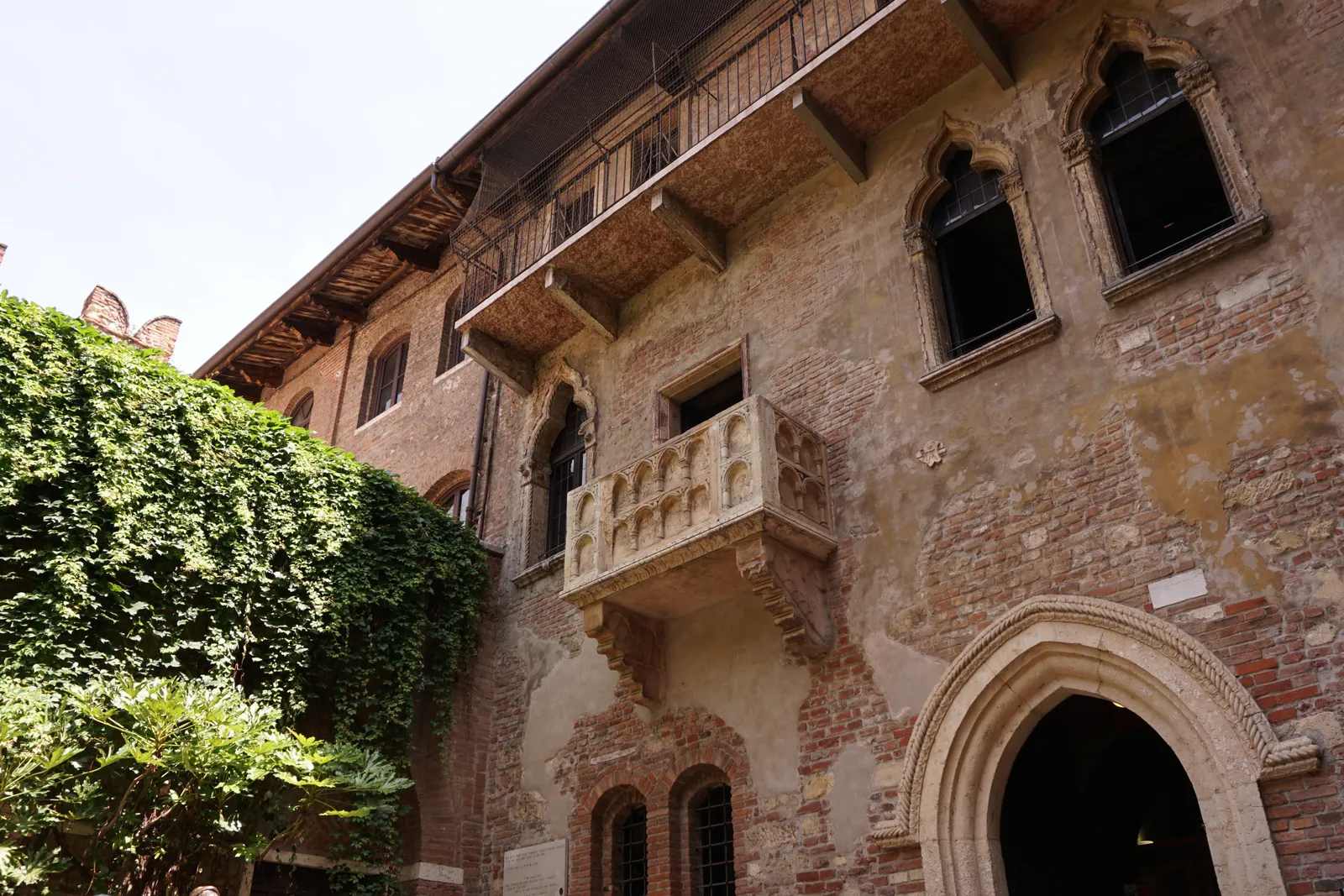
Arrive in the piazzetta about ten minutes before your slot, and use any spare margin on the square itself rather than standing in file — the entry runs in short admission waves, and there is no advantage in being first against the door. Inside, the visit unfolds as the site now intends: the theatre's halls, then the courtyard with the bronze Juliet and the letters wall, then — if you have taken the full house entry — the frescoed floors, the Zeffirelli film exhibit and your turn on the balcony itself. Budget 45 minutes for a courtyard visit and 75 to 90 for the full house at a civilised pace.
A word of expectation-setting for first-timers, because it is the concierge's honest duty: the house is a small medieval building wearing a 20th-century costume, and it is wonderful precisely when you know that. The balcony was assembled in 1939 from medieval stone to give the legend a stage; the statue is a 2014 replica of a 1968 bronze that visitors' hands wore through; the letters on the wall are real and often startlingly sincere. Visitors briefed on those three facts consistently rate this the most interesting stop of the circuit. Visitors expecting a documented Capulet palace rate it a queue. Be the first kind.
Piazza delle Erbe, the Lamberti Tower and the Civic Squares
Two minutes from Juliet's House, Piazza delle Erbe is where Verona has done business since it was the Roman forum — an elongated market square walled with frescoed facades, the Baroque Palazzo Maffei closing one end and market umbrellas still filling the middle most days. At its centre stands the fountain of Madonna Verona, the medieval statue that has served as the city's emblem since the 14th century; connoisseurs of the Juliet story should pay her particular attention, since Verona tradition links her serene figure to the design of the bronze Juliet you have just met in the courtyard. The square asks for no itinerary — circle it once with your eyes up, then pick a cafe edge and let it move around you for a quarter of an hour.
Rising over the square's corner, the Torre dei Lamberti is the city's great medieval bell tower and its best legal viewpoint. If your legs and schedule allow one more ticket, the climb — eased by a lift for most of the height — pays out the entire morning in one panorama: the Arena, the river's hairpin, the Alps on a clear day, and the terracotta roofscape hiding every stop you have walked. Allow 30 to 40 minutes including the queue. Beneath and beside it, through an archway, Piazza dei Signori offers the quieter, statelier counterpoint to the market square: Dante's statue at the centre — the exiled poet who name-checked the feuding Cappelletti and Montecchi long before Shakespeare found them — surrounded by the palaces of medieval Verona's government.
Just beyond Piazza dei Signori stand the Arche Scaligere, the extravagant Gothic tombs of Verona's ruling della Scala family, spiky with pinnacles behind their wrought-iron fence — a two-minute detour and one of the most startling medieval ensembles in Italy, free to view from the street. This is the natural far turn of the half-day circuit. From here you can drift back through Piazza delle Erbe towards Via Mazzini and the station side, or — if the story has its hooks in you — commit another hour to the extension below.
The Extension: Juliet's Tomb at San Francesco al Corso
The legend has a second address, and almost nobody goes. Juliet's Tomb lies in the crypt of the former convent of San Francesco al Corso on Via Luigi da Porto — a street aptly named for the novelist who fixed the lovers in Verona — roughly a fifteen-minute walk south-east from the Casa di Giulietta quarter, outside the main tourist current. The convent itself was founded in 1230; the red marble sarcophagus, empty and lidless, has been identified with Juliet since a legend already reported in the 16th century — a tradition older than the house's own claim — and was moved to its present crypt setting in 1938. Pilgrims have honoured it, chipped it and left it letters for centuries.
The same complex houses the G.B. Cavalcaselle Fresco Museum, established when the restored convent opened as a museum in 1973, and a single entry covers both: detached frescoes rescued from Veronese buildings, the reconstructed 16th-century mythological cycle of the Sala delle Muse, and statues from the Scaliger tombs you passed in the centre. Hours are Tuesday to Sunday 10:00 to 18:00 with last entry at 17:30, closed Mondays, 25 December and 1 January — note the Monday closure carefully, because it is the day your Juliet's House slot cannot start before 14:00 either, making Monday the wrong day for the full lovers' pilgrimage. The complex is also Verona's civil wedding venue, so you may share the cloister with a bridal party, which feels exactly right.
Should you go? On a strict half day, only if the Romeo and Juliet thread — rather than Verona generally — is what brought you. The tomb is the story's melancholy bookend: where the house is theatrical, crowded and bright, the crypt is bare, quiet and oddly moving, and the pairing is the point. Travellers doing the extension should sequence it last, after the civic squares, and allow a full hour including the walk each way. Those saving it earn the classic excuse for a return visit — half a day shows you Verona's face; the tomb, like the city's churches, Castelvecchio and the Roman theatre across the river, belongs to the fuller acquaintance.
Two Ready-Made Schedules
The morning plan, for a 10:30 house slot, Tuesday to Sunday: arrive Porta Nuova around 08:45 and walk up to Piazza Bra; Arena exterior (or a fast interior visit at opening) until 10:00; Via Mazzini stroll to Piazzetta Navona for the 10:30 slot; full house visit until about noon; Piazza delle Erbe and the Madonna Verona fountain; lunch off the square; then the Lamberti tower climb or the Piazza dei Signori and Arche Scaligere walk — both if you are brisk — and back down Via Mazzini to the station side by 14:30. This is the calmest version of the day: you ride ahead of the coach-group wave at every single stop.
The afternoon plan, for a 15:30 slot, works better for Lake Garda day-trippers and anyone arriving at midday: Piazza Bra and the Arena from 13:00, with the interior visit while the light is high; Via Mazzini window-crawl; Piazza delle Erbe, Piazza dei Signori and the Arche Scaligere in the mid-afternoon lull; the 15:30 house slot as the emotional summit; then the tower climb around 17:00 for late light on the roofscape, or the tomb extension for the committed; aperitivo on Piazza Bra as the Arena crowd assembles. On Mondays this plan is mandatory rather than optional — the house opens at 14:00 — and the tomb drops out entirely, being closed.
Three tactical notes finish the job. Wear real shoes: the circuit is short but runs entirely on stone, and the tower and house both mean stairs. Check the calendar for opera nights and city events before choosing morning versus afternoon — an opera evening electrifies the city but thickens every cafe and train after 17:00. And hold the day loosely: the itinerary above survives contact with reality precisely because only one stop is timed. If the market swallows an extra half-hour or a church door stands invitingly open, let the plan bend. Verona in half a day is not a checklist; it is one booked slot with a beautiful city arranged around it.
Frequently asked
Is half a day really enough for Verona?
For the essential circuit, yes. The Arena, Via Mazzini, Juliet's House, Piazza delle Erbe and the civic squares sit within a fifteen-minute walk of each other on flat, pedestrianised ground. Four to five hours covers the circuit including a full house visit; a whole day adds interiors, churches, Castelvecchio and the Roman theatre.
What should I book in advance for a half-day visit?
Only the Casa di Giulietta entry slot is essential — the house admits exclusively by pre-booked timed slot, with no ticket office at the door. The Arena and the Lamberti tower sell entry more flexibly, and the piazzas are open streets. Book the house slot first and build the circuit around it.
Should I do the Arena or Juliet's House first?
Whichever your slot dictates — that is the point of booking the house mid-circuit. Coming from the station you reach the Arena first naturally, so a late-morning or mid-afternoon house slot creates the smoothest chain: Arena, then Via Mazzini, then the house, then Piazza delle Erbe and the civic squares.
Is Juliet's Tomb worth adding to a half day?
Only if the Romeo and Juliet story specifically is your thread. The crypt at San Francesco al Corso — with its empty red marble sarcophagus, a legend reported since the 16th century — is quiet and genuinely affecting, but it sits fifteen minutes off the circuit and costs about an hour with walking. It is closed Mondays.
What changes on a Monday?
Two things: Juliet's House opens at 14:00 rather than 09:00, forcing the afternoon version of the circuit, and Juliet's Tomb with the Fresco Museum is closed altogether. The Arena, the piazzas and the tower carry a Monday morning perfectly well, but the lovers' pilgrimage itself is an afternoon-only affair.
Where does the circuit start from Verona Porta Nuova station?
Walk straight up Corso Porta Nuova for ten to fifteen minutes to the Portoni della Bra gate and Piazza Bra, where the Arena stands — or take a city bus towards Piazza Bra to save the first kilometre. Everything else on the circuit is closer together than the station is to the centre.